
When Should a Growing Logistics Company Outsource Blue-Collar Hiring? 5 Signs You've Outgrown In-House
A practical guide for founders, operations heads, CFOs and HR leaders building warehouse, delivery and supply chain teams in India
A new warehouse opens in three weeks. A customer contract needs 120 people on the floor by the first of the month. Peak season is around the corner. And your hiring team is still working through last quarter's list of open roles.
If that sounds familiar, you are not short of effort. You are probably running a hiring model built for a smaller company.
In logistics and supply chain, blue-collar hiring is not a side function. It decides whether trucks leave on time, parcels are sorted on schedule and promises to customers are kept. Yet many growing companies still run it the way they did at 50 people: a few job posts, a referral or two, and operations managers filling the gaps themselves.
Here is how to tell when that approach has reached its limit, and what to do about it.
Why blue-collar hiring has become a strategic problem
Three realities make this question more urgent in 2026.
1. The sector is huge, and still growing. India's logistics sector employs roughly 22 million people and is projected to need around 28 million by the end of the decade, according to NSDC figures cited by Air Cargo Week. Industry estimates suggest the sector could create 8 to 10 million new jobs by 2030. At the same time, only about 4.7% of the workforce is formally skilled, and close to 70% of logistics jobs remain informal. Growth is not the problem. Finding trained, documented, job-ready people at the right place and time is.
2. Demand is peaky, and it is getting more precise. The TeamLease Festive Season Workforce Report 2026 expects temporary hiring to rise 15 to 20% across retail, e-commerce, quick commerce and logistics, led by South and West India, with Bengaluru, Hyderabad and Chennai among the key hubs. It also expects frontline salaries to rise 8 to 10% in the second half of 2026. Interestingly, the report found no major shortage of workers in warehouse and customer-facing roles. The shift is from volume hiring to what it calls precision hiring: dark-store associates, warehouse automation operators, and quality-check and returns specialists. Meanwhile, hiring is spreading beyond metros, with one staffing firm estimating that tier-II and tier-III cities will account for about 45% of festive hiring demand.
3. Churn is built into the model. Deloitte India's Blue Collar Workforce Trends 2025 report found that about 69% of blue-collar hires are temporary, with low permanent conversion and an average tenure of around 21 months. Hiring is not a one-time event. It is a continuous cycle of replacing, scaling and redeploying.
The result is a paradox many leaders will recognise: plenty of candidates, yet too few of the right ones who actually join, stay and perform. Here are the five signs that your in-house setup can no longer keep up.
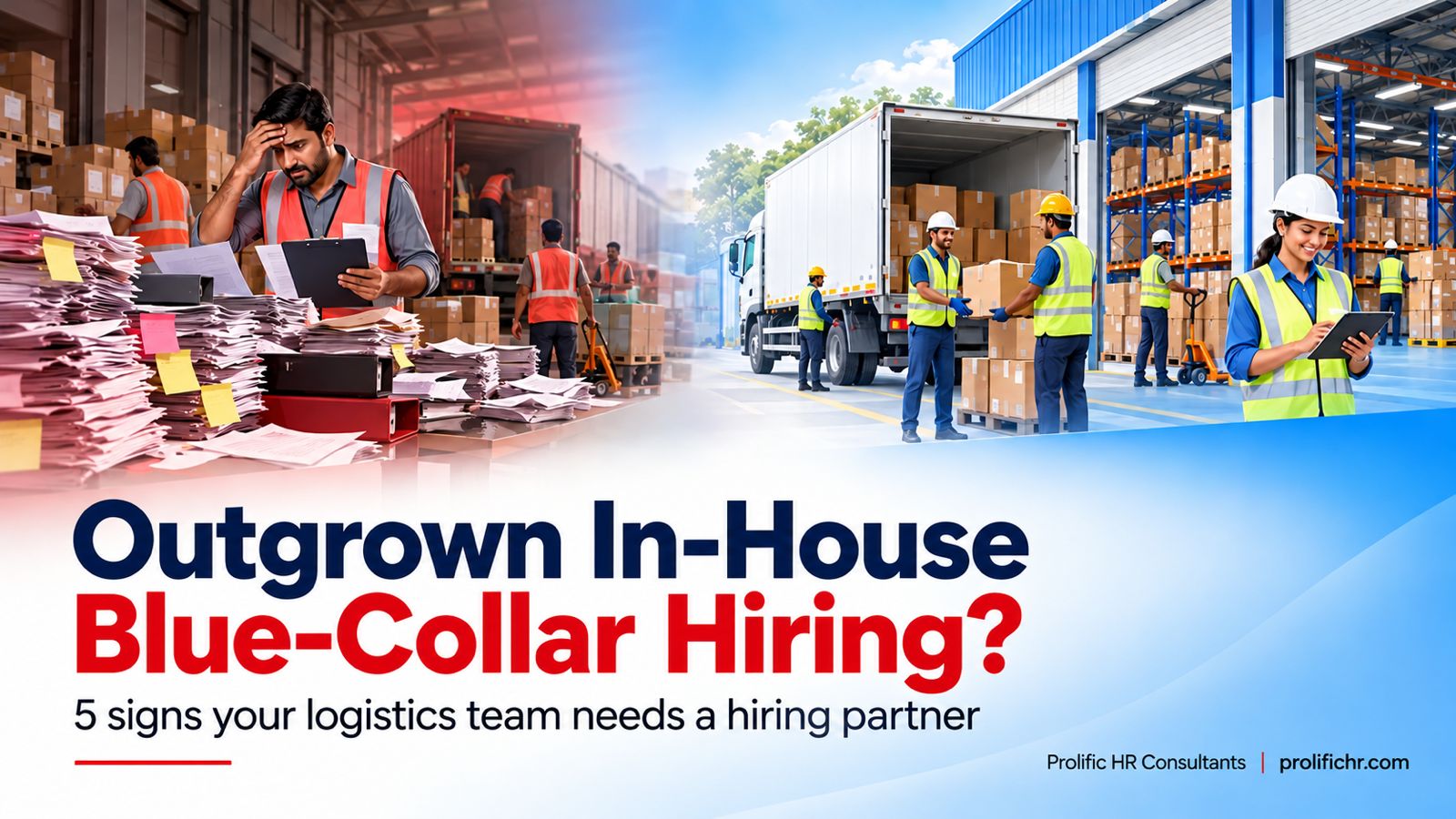
Sign 1: You are always hiring after the demand has already arrived
Who feels it most: Operations heads and founders
The warehouse opens and the team is half-staffed. The festive peak begins and temporary hiring is still underway. A new customer contract starts and supervisors are covering shifts themselves.
When the time to fill a role is routinely longer than the time you have before the work starts, your hiring is reactive by design. A vacancy that stays open for weeks, even with hundreds of applications, usually points to process problems: unclear requirements, slow approvals, weak screening, or a limited sourcing pool, rather than a true shortage of people.
Ask yourself: For our last three hiring surges, did the team arrive before the demand did? By how many days were we late?
Sign 2: You are hiring the same roles again and again
Who feels it most: CFOs and HR heads
Roles are filled, then reopen a few weeks later. Your recruiters spend most of their time on replacements, not growth. Every metric that counts closures looks fine, while the real headcount on the floor barely moves.
With short average tenure being normal in blue-collar roles, the question is not just how fast you hire, but how many people are still with you at 30 and 90 days. A cost-per-hire figure that ignores early exits hides the true cost, which includes repeated sourcing, onboarding, training and lost productivity.
Ask yourself: What percentage of people we hired in the last quarter are still with us after 90 days? Do we even track it?
Sign 3: Offers are made, but people don't turn up
Who feels it most: HR heads and operations managers
You offer 100, and 70 join. Candidates accept, then accept something else. Documents are incomplete, so joining dates slip. A gap of a week or two between offer and joining is enough to lose people to the next employer.
This is usually fixable, but it needs follow-up that most in-house teams do not have time for: confirming joining dates, resolving document gaps, communicating clearly on location, shift and pay, and staying in touch until the first day. Common reasons selected candidates fail to join include delayed offers, unclear role expectations, compensation gaps and weak communication between selection and joining.
Ask yourself: What is our offer-to-joining ratio, and what happens to a candidate between the offer and the first shift?
Sign 4: You are expanding into places where you have no local network
Who feels it most: Founders and COOs
A new hub opens in a second or third city. A fulfilment centre comes up near a tier-II town. Blue-collar hiring is intensely local. The best talent comes from nearby catchments, local networks, walk-in drives, training institutes and community referrals, and wage norms vary city by city.
Building that local sourcing machinery from scratch in every new location, with a central HR team, is slow and expensive. Hiring close to where the work is, and having ready-to-deploy people there, is exactly where an experienced external partner with an existing talent pool shortens the timeline.
Ask yourself: In our newest location, how did we find our first 50 people, and how long did it take?
Sign 5: Your operations managers are doing HR's job
Who feels it most: Operations heads, CFOs and HR heads
Shift supervisors are screening candidates, chasing documents and tracking attendance. Joining paperwork lives in different places. Payroll inputs arrive late and incomplete. Nobody is quite sure who is accountable when something goes wrong.
This is the hidden cost of in-house blue-collar hiring: it pulls your best operational people away from running operations. It is also a compliance risk. India's four Labour Codes, in force since 21 November 2025, bring contract labour, wage definitions, and social security (including recognition of gig and platform workers) into sharper focus. Where contract workers are involved, the principal employer can carry responsibility for what happens in the vendor chain, so complete records and clear responsibilities matter more than ever.
Ask yourself: How many hours a week do our operations managers spend on hiring, onboarding and paperwork, and what are they not doing instead?
A quick self-assessment
Count how many of the five signs sound familiar.
0 to 1 signs: Your in-house approach is probably working for now. Document your process and track retention so you spot early warning signs.
2 to 3 signs: Consider a hybrid model. Keep strategic and supervisory hiring in-house, and bring in a partner for volume hiring, peak seasons or new locations.
4 to 5 signs: The cost of delay is likely higher than the cost of change. Evaluate a structured manpower and recruitment partner seriously.
What good looks like when you outsource blue-collar hiring
Outsourcing does not mean losing control. The best arrangements are clear, measurable and shared.
Start with the role, not the headcount. A good partner begins by understanding the work: shift patterns, skills needed, wage bands, locations and the real difference between a picker, a packer, a forklift operator and a dispatch coordinator.
Agree on metrics that matter.
• Time to deploy, from requirement to first day on the floor
• Offer-to-joining ratio
• 30-day and 90-day retention
• Cost per successful joining, not per resume
• Completeness of joining documents and compliance records
Ask the right questions before you sign.
• What local sourcing channels do you actually have in our locations: walk-in drives, institutes, community networks?
• How do you screen and verify candidates?
• What are the replacement terms if someone leaves early?
• Who handles onboarding documents, attendance coordination and payroll inputs, and who is accountable for statutory records?
• How quickly can you scale up for a peak and scale down afterwards?
Know when not to outsource yet. If your role definitions, wage bands and shift rules are still unclear, outsourcing will only move the confusion elsewhere. Fix the basics first. A good partner will tell you the same.
Where blue-collar hiring is heading
From volume to precision. Employers want people who can work with scanners, warehouse systems and automation from week one. Skilling and certification will increasingly sit alongside recruitment.
Hyperlocal and tier-II/III hiring. Expect more sourcing close to fulfilment centres and hubs, which shortens deployment time and reduces early drop-offs.
Formalisation of work. With a large share of logistics jobs still informal, the push toward documented employment, social security and structured onboarding will continue, helped by the Labour Codes.
Technology in screening. AI-assisted screening, digital documentation and joining trackers are becoming standard for high-volume hiring.
Seasonal planning becomes year-round. Peak hiring is starting earlier, and the companies that win are building talent pipelines before demand arrives, not after.
The common thread: blue-collar workforce planning is moving from a recruitment task to an operational capability.
The better question
Most leaders ask, "Can we afford to outsource blue-collar hiring?" A better question is, "What is our current model costing us in late deployments, repeat hiring, early exits and distracted managers?"
If two or more of the signs above sound familiar, it is worth a conversation. Not necessarily to hand over everything, but to design a model that fits your locations, peaks and workforce mix.
At Prolific HR Consultants, we have supported employers with recruitment and workforce solutions for more than 20 years from Bengaluru, including bulk hiring, walk-in drives and pre-screened talent pools for logistics, retail and other workforce-intensive sectors.
Planning a hiring surge or a new location? Message us or write to admin@prolifichr.com. Visit prolifichr.com to know more.
Which of the five signs do you recognise in your operation? Share in the comments, we would like to hear how other leaders are handling it.